The System works because you work!

The System works because you work!

DEATH BY GOVERNMENT: GENOCIDE AND MASS MURDER

DEATH BY GOVERNMENT: GENOCIDE AND MASS MURDER
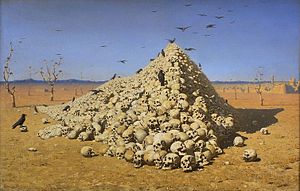
All told, governments killed more than 262 million people in the 20th century outside of wars, according to University of Hawaii political science professor R.J. Rummel. Just to give perspective on this incredible murder by government, if all these bodies were laid head to toe, with the average height being 5', then they would circle the earth ten times. Also, this democide murdered 6 times more people than died in combat in all the foreign and internal wars of the century. Finally, given popular estimates of the dead in a major nuclear war, this total democide is as though such a war did occur, but with its dead spread over a century

Popular Posts

Saturday, March 26, 2011

Fear and devastation on the road to Japan's nuclear disaster zone. Imagine if this happen to your town? How safe are we?


Fear and devastation on the road to Japan's nuclear disaster zone

Daniel Howden travels through a post-tsunami wasteland to the gates of the stricken Fukushima Daiichi power station
Saturday, 26 March 2011
At the gates of the Fukushima Daiichi power station
FRED DE CONDAPAPPA
At the gates of the Fukushima Daiichi power station
SPONSORED LINKS
Ads by Google

Free Blood Press Monitor
Try RESPeRATE To Lower Blood
Pressure + Get a Free BP Monitor
www.RESPeRATE.com/FreeBPMonitor

Island Paradise, Taiwan
Free 1 night hotel w/1 paid night
Take the offer right now!
www.go2taiwan.net

Sharp Solar Cells
Leading the world with an energy
conversion efficiency of 35.8%
sharp-solar.com

First Class Airfare For
Less--Up to 60% Off International
First Air-- Cook Travel
www.cooktravel.net
Once this road was thronged with traffic: an expressway, one of the arteries of a nation's economic life, as familiar and modern a sight as you would find anywhere in Japan. The only barriers on the route to Fukushima Daiichi were the other people heading in the same direction.
Today the journey is different. It is a journey to the heart of a catastrophe. About 10 kilometres beyond the half-deserted city of Iwaki, the coastal road is blocked not by commuters but by landslides; the satellite navigation system that might once have flashed up traffic jams shows clusters of red circles that denote barred roads. And when we reach the inland expressway itself, the only vehicles disturbing the silence are the rumbling military trucks of Japan's Self Defence Force. Twenty kilometres out from the nuclear plant, abandoned road blocks mutely signal our entry into the nuclear exclusion zone.
It is a scene of devastation. Underneath us the road cuts across rice fields strewn with cars, their wreckages seemingly tossed by the hand of an angry child: in one paddy an upturned Nissan Micra; in another a Toyota people carrier filled to its sunroof with mud. The second storey of a nearby house perches on a single pillar, like a boxy flamingo. The ground floor has been erased, splinters of wood pointing the way the wall of water had gone.
And yet after two weeks of minutely documented destruction, these scenes seem more familiar than eerie. The empty streets on the hillside of nearby Kumamachi, which escaped the tsunami, attest to a different kind of fear. Outside its abandoned houses a gentler tremor has shaken roof tiles to the floor and knocked over bicycles. But it feels as though the residents could return at any moment. Their doors are open.
The people here must have been able to hear the hydrogen explosions that rocked the power plant only three kilometres away. They can't have waited much longer to leave. No one will see the cherry blossom that's opening on the boughs of a tree in the school playground, or observe the custom to share a drink underneath it with friends. The children's umbrellas will stay in the rack outside their empty classroom.
Stray cats provide a flicker of movement as they wander in the newly emptied landscape. A few dogs have been left behind, one trailing its lead. In a village beneath one of the flyovers on Route 6, an elderly couple emerge from their car and run into a house. By the time we backtrack and climb down to find them they have gone.
Despite the hundreds of homes still standing they will be the only non-emergency workers we see. Their fleeting presence is a reminder of our own vulnerability, even inside a sealed car on a deliberately brief journey through the zone. We only venture outside the vehicle to remove heavy debris in our way. As we edge closer to our destination, we make our way over buckled tarmac where sand has been shovelled into yawning cracks and logs have been rolled into the broken steps carved by the earthquake.
The brooding presence of the Fukushima Daiichi nuclear power plant is telegraphed by the crowds of transmission-tower pylons converging on their source. A stream of white vehicles manned by ghostly figures in protective overalls, all breathing through respirators, suggests no let-up in the fight against a meltdown.
Finally we are seeing people on our journey. When we wave one of the vehicles down, the driver removes his respirator long enough to say that yes, he is working on the emergency at the plant. But his speech is flecked with panic. He insists he cannot speak to journalists and hurries away.
But nobody stops us. And so we move closer. Tell-tale wisps of grey smoke rise above the tree cover to point the way. Japan's newest heroes, the "Samurai 50", flash past, almost invisible in their white body-suits and hoods aboard a white bus, going towards the reactors. Before long we, too, are at the main entrance of Fukushima No 1.
In the midst of an all-consuming havoc, it appears to be the only place that has escaped intact. Only a spotless white sign in the stone wall tells us we are at the centre of the crisis. Next to the Japanese characters that give the plant's name is the playful red logo of Tepco, the now notorious Tokyo power giant that finds itself in the eye of a nuclear storm.
We would learn later that Tepco has belatedly admitted that the pressure containment vessel at reactor No 3 "may" have been breached – the last step before molten fuel pours onto the concrete base of the reactor triggering a massive release of radioactive material. Three workers inside the plant have been taken to hospital with burns after wading into water contaminated by 10,000 times the expected dose of radiation.
The half-dozen reactors where small teams of engineers have been battling in shifts to prevent a meltdown are only a few hundred metres away. But even if the risks are manageable on a brief visit, there is no mistaking that we are close to disaster.
A Tepco vehicle comes in the other direction but stops abruptly on seeing a car from the outside world inside the stricken power plant. It reverses noisily towards us, and the driver's door opens to show two men inside wearing heavy-duty protective overalls. Unable to make themselves heard over respirators, they make the Japanese gesture meaning "forbidden", crossing and uncrossing their arms and then pointing back the way they had come. It was the closest thing to a security barrier that we encountered.
Our route away is just as unimpeded. But if the approach has been a powerful introduction to the destructive force of the tsunami, our journey towards Minamisoma, the nearest town to the ruined plant, does not offer a corresponding escape.
The town is trapped in what the government has called the "stay inside zone": a 10km-wide band not yet evacuated but too contaminated to go outside. As we escape the perimeter of the plant, the final stretch of Route 6 into Minamisoma breaks through the numbness. Remnants of boats and cars are scattered in unlikely poses for miles in all directions, while the pylons that flank the road have been twisted like the Spanish bearded trees of the bayou. Crows pick through the wreckage of a destroyed garden centre on the roadside.
The ghastly spell is broken by loudspeakers in the distance that are somehow still working. One of Japan's beloved town announcements echoes across the grey devastation, repeating the promise that petrol and kerosene rations will arrive that afternoon.
Picking our way through we find Haranomachi Tokusawa. An old man, he seems less terrified than others of the radiation and has taken his pickup down to the coastal stretch of Minamisoma to look for people lost in the maze of smashed junctions. "It's not safe for you here, you're still inside the exclusion zone," he warns, before leading us out to where everyone else is sheltering.
Only 20,000 of Minamisoma's population of 70,000 have stayed on here. In his office plastered with photographs of the aftermath, Sakurai Katsunobe, the town's lean and furious mayor, says residents have been left to fend for themselves. "Everyone here is angry with Tepco," he seethes. "They give us no information and no help."
Joking that he's a samurai, he vows to save his town with its crippled power plant, its poisoned rice paddies and terrified survivors. He is unlikely to get the chance. Late yesterday the government expanded the evacuation zone in response to the deepening emergency at Fukushima. Even the brave hangers-on will have to pack what they can and leave.
But until that order came, the few that remained were inhabitants of a kind of ghost world, removed entirely from the ordinary life they had once lived. Weighing that new reality in his office, Katsunobe stared at the images of devastation tacked to his wall. They were placed over the pictures that had decorated the room in more normal times. "We can't get supplies as drivers don't want to come here," he said. "We're like an island cut off from outside world."
SPONSORED LINKS
Ads by Google

Add New Comment

Showing 1-30 of 110 comments

Sort by    Subscribe by email   Subscribe by RSS
  • I object to the attempt at jerking tears from your readers. Yes these people are in a bad situation. Yes, I feel bad for them. But they deserve more than a handwringing piece of overly dramatic rubbish.

    With so much strength and character being displayed by the many residents and rescuers, you focus entirely on the doomiest/gloomiest point of view.

    Bah.
  • The writer describes the uniquely apocalyptic landscape of an unprecedented disaster. Other writers are simultaneously doing other types of writing. It doesn't have to be one or the other.
  • You might be right but I think it would be mighty neighborly for us to sponsor refuges if we can afford it and have the space in our homes, millions may be displaced.
  • You can take in as many descendants of the perpetrators of the Bataan Death March as you feel will assuage your guilt complex.
  • I was an engineer working in a diff't industry on a safety project. I developed some equations to speed up and help an operation. I was threatened when ready to show them to a reliable mill manager. Later, some immediate supervisors took the credit. I later was key in designing a tilt measuring device. Others also took credit. The device needed extreme calibration for safety reasons to prevent pressurized vessels from exploding. I figured out how to do it, but was prevented. I was later threatened again, this time with a high up manager puffing cigar smoke in my face, telling me not to make-known our safety information to the inustry at large. I then decided to go to Bible college. Few people would even talk with me after my decision. Later I heard someone got hurt or died, probably prevented if they listened to me, and the high-tech company I worked for closed down. Japan-like and Space-shuttle disasters will continue as greed, lust, and unethical practices grow due to a hatred for Biblical & professional ethics.
  • I too have worked in the Engineering industry, albeit another discipline. You are correct in your assessment; cost control often overrules safety and longevity. I was once charged with testing a part for Rotor Wing aircraft, they planned a destruct limit that could have been increased at no additional cost but the clients would have brought fewer replacement parts. The clients were multi-national governments including our own.
  • Bible ethics? I assume aren't referring to the old testament ethics then?
  • Oh, you mean like watching after your neighbor, working for your income instead of ripping others off, not stealing, murdering, committing adultery, avoiding sexual immorality, or coveting your neighbors property or relationships?
  • You should study the Jewish Talmud, you just might be surprised. But then you most likely don't want to understand Truth. Even this is covered in understanding from the ancients.
  • >"Even this is covered..."
    Saaaaaaayyyyyyyyyyy WHAT? The ancients understood and wrote about nuclear disaster? Do Tell!
  • What a quack article written to build nothing but fear. You are not journalists, you are nothing but sensationalists.

    You should be ashamed
  • Wow, I had a very different reaction. I found the article superbly written and one that, while only posted today, could go down in history as it paints the picture of a world so many of us have only imagined. Bravo for not just telling us but "showing" us.
  • its a bit flowery

    e.g.

    "The second storey of a nearby house perches on a single pillar, like a boxy flamingo"

    "the pylons that flank the road have been twisted like the Spanish bearded trees of the bayou"


    how about perched on a single pillar like a lollipop, or twisted like the murderous mind of a serial killer
  • Or... "the twisted pylons, hearkening in their stark soul-less metal frame, to the stoic resolution of the Kamikaze pilots which gave their lives to attack the evil USA."
  • Straight reporting. Very clear, your term 'quack' - define how that applies to a straight reporting piece? This happened, it's not some point you get to argue. The fact of a large earthquake followed by the inevitable tsunami that followed was outside the design parameters for the construction of the nuclear facility. There is absolutely nothing sensational about it. What gives me pause is how completely and utterly foreseeable this was. Nothing 'Sensational' about it.
  • Apocalypsetuesdayweek 9 hours ago in reply to oldnavynuke
    Well looka here, looks like we git us a real live one!! Does anyone smell denial.

    TBH you and your lot are getting on my wick. say something new or do one,
    people are suffering while you re coming out with this crap. .
  • People suffered 60 miles of torment and death on the Bataan Death March.
  • The truly sad point here is the ignorance of nuclear power... we see numbers like 10000 times normal and don't realize there is more radiation in a banana (k40). This is a real nuclear emergency and caution is warranted, but it is also fear mongering by those with an agenda... more people will die from coal mining this and every single year. This just sells more copy and lines up with a preconceived idea...
  • Is there more radiation in a banana than leaked water from a nuclear power station? Why dont we run the power stations on bunchs of bananas then?
  • DaveMart 5 hours ago
    The 'catastrophe' was the earthquake and tsunami, which killed over 20,000 people, including from massive oil and gas fires, and including anyone who was in the 1,800 homes that were swept away in a dam break.
    There has been and it is very unlikely that there will be any large number of deaths from the problems at the nuclear reactors, most of which shut down just fine, and at just a few of which a wall of water up to 12 metres high has caused problems, but they performed way beyond their design capacity.
    Oil and gas installations in contrast simply went up. No talk of 'safeguards failing' there, because effectively they are impossible.
    Huge clouds of carcinogenic smoke were also released by them, which will certainly cause many deaths in the future.

    The media's inept and sensationalistic reporting of the supposed 'catastrophe' at the nuclear plants is a manufactured story, and although of course the issue is serious it is absolutely nothing compared to the real catastrophes which have occurred, and in which every other energy form including renewables played a major plant.

    Greenpeace has been banging on for years that we are all doomed if there is melt. Well, we have had three of them at the same time now, but the likeliest outcome is that we will have no fatalities, just as there were zero from Three Mile Island where the containment dome did it's job.

    As for the allegation that Tepco is has been hiding the information that the containment is cracked, it has been and continues to be unclear whether that has happened. They can't tell you what they don't know, and they can't really get in close to find out yet.

    Since the reporter is heavily critical of TEPCO for allegedly not doing it's job, perhaps he should make sure that he does his own by finding out what he is talking about and reporting that, rather than purveying sensationalist and unbalanced hype.

    Those who are genuinely interested in finding out what has happened should google 'Brave New Climate' and look at the discussions there for rational assessment instead of ignorant hype.
  • I am relieved to now know that all is well with the nuclear plants.

    I was under the impression that the whole set up was a mess, from building them on a fault line to having back up cooling systems that failed.

    So now we can start copying the Japan, anybody know a dodgy site to build the first of many?
  • Wow, these are pretty tough reactors, to bad they had the backup generators in the basement of the facility. If it hadn't been for that planning blunder those plants would be up and running.
  • Isn't that true of every disaster? "If only the thing that broke hadn't have broke, there'd be no problem". The point is that it did - and the entire system is only safe when it all works.
  • I appreciate good reporting.

    But I object to the subtitle 'heart of darkness.'

    Mind your own business.
    The phrase is more applicable to Palestine/Israel, Yemen, India/Pakistan/Afghanistan/Sri Lanka/Bangladesh/Burma, Sierra Leone, Kenya, Nigeria (I don't think the list is exhaustive enough).
  • Well Said my Friend! Domo Arigato!
    Yokosuka, Japan
  • I agree. The west is finding it harder and harder to mind its own business, these days.
  • I am not inclined to full agree with your statement about the west, however, the news media is sensationalizing not only this tragic event(s), but others for the sake of headlines.
  • What total and utter rubbish! Who do you think you are?
  • In San Onofre, San Diego County California sitting on the San Jacinto fault are a couple of giant white domes, out by the shore, surrounded by sand, visible from the coast highway, the locals call them two nuclear reactors "the Dolly Partin's"...Inside those huge domes are MOX fuel reactors. The same type of fuel as used in reactor #3 at Fukushima, the one causing most of the worry and trouble... Mox fuel is TWO MILLION times more deadly than uranium fuel, the type of fuel used at the Chernobyl plant, And that plant is responsible for ONE MILLION deaths since its meltdown.

    Should anyone feel safe in the USA, Have you ever looked at the Jet Stream and how fast a disaster like Japans would cover the whole country ONE DAY...but don't worry America the plant is built to withstand a 7.0 earthquake and has a 25ft sea wall protecting the country from a Tsunami. If San Onofre ever goes Chernobly, it will cause a disaster coast to coast.


    a 7.0 is 100 times less poweful than the 9.0 quake in Japan

    and the Nuclear Industy bloggers will say, Anything for a Buck, they can Buck off and go to H e l l
  • Your screen name belies the obvious: you are a moron.
1 2 … 4 Next 

No comments: